We tend to think of dangerous children’s toys as something from the past. But check out this list of banned children’s toys — which includes 2007’s best seller, “Aqua Beads.”


We tend to think of dangerous children’s toys as something from the past. But check out this list of banned children’s toys — which includes 2007’s best seller, “Aqua Beads.”
 Sometimes truth is stranger than fiction. You couldn’t make a place like Action Park up. Action Park was a New Jersey amusement park open from 1978 until 1996. Somehow I stumbled across its Wikipedia page. I half-thought the Wikipedia page was apocryphal, but, after consulting with several friends of mine from New Jersey, Action Park, was a real, once thriving, amusement park.
It earned the nickname of “Accident Park” from physicians at the local ER who treated untold numbers of park patrons who wound up injured.
What were the dangers of Accident Park? To my mind, the piece de resistance was the loop-the-loop waterslide partially pictured at left. This waterslide actually turned the riders upside down without them being belted or strapped into any sort of carriage. According to Wikipedia, when the park’s owners sent crash test dummies down the slide, some of the dummies wound up dismembered and decapitated. Eventually, the park’s owners decided to have park employees test out the ride and offered $100 to any park employee who would venture on the slide. According to the brave employee who stepped forward for the sake of “safety” at Action Park, “$100 did not buy enough booze to drown out that memory.”
Other problems at Action Park? Like many parks, Action Park had an alpine slide. But Action Park’s sleds were poorly maintained meaning, in practice, riders could only use the stick which controlled speed to choose between “extremely slow” and a speed one park employee descried as “death awaits.”
For skaters, Action Park boasted a poorly-constructed skate park where the edges of pavement often did not meet smoothly. As one park employee recalled, the “skate park was responsible for so many injuries we covered it up with dirt and pretended it never existed.
Popular ride “The Kayak Experience” simulated white water rafting with powerful fans submerged beneath the water to agitate the water. The hazards of this ride are obvious even without the benefit of hindsight.
Like many amusement parks, Action Park had go-carts. But its go-carts traveled in excess of 50 mph, leading to some pretty horrific injuries.
As the Wikipedia page notes, “Little action was taken by state regulators despite a history of repeat violations.”
It was trial lawyers who forced the park to shutter its doors and reopen many attractions under the newer, safer management of Mountain Creek.
For more on the unbelievable story of Accident Park, check out the Wikipedia page yourself.
We’ve blogged a lot about SawStop technology, the revolutionary flesh-detection technology that renders power saw accidents obsolete (see here, here and here).
Now comedian Stephen Colbert tells the story of inventor David Gass’ David-and-Goliath struggle against power tool manufacturers. (Warning: language and other objectionable content).
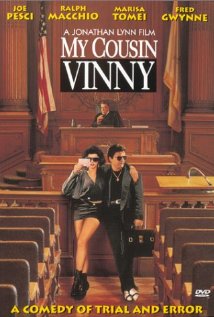 This month marks the twentieth anniversary of the premiere of the film My Cousin Vinny and, to commemorate the occasion, our friends over at Abnormal Use have invited legal bloggers to post their thoughts on the film. Abnormal Use itself will feature a series of posts over the week, including interviews with Vinny’s producer and screenwriter. You should check them out.
To me, Vinny is not only a great courtroom movie; it’s a great comedy. I think the comedic elements that make it so great come from the fact that we have two fishes out of water here — Brooklynite Vinny and the befuddled Beechum County citizens who are forced to deal with him. Both sides are aware of their difference, yet neither condescends to the other; they are all humble, likeable people searching for common ground. At one particularly bungling moment, Vinny’s fiancee mocks him, “Gotta let everyone know you’re a tourist.” As Vinny replies, “What are you, a f—— world traveler?” Vinny’s full of braggadocio and confidence, but he doesn’t think he knows it all.
But the heart of comedy is an elusive subject and too often, in talking about it, the comedy slips through the critic’s fingers. And so I think, rather than analyzing what makes Vinny such a hilarious movie, I’ll stick to what I should know best: how Vinny rates as a courtroom movie, in terms of its courtroom realism.
No movie makes perfect marks on this score. The urge for screenwriters and producers to crank up the courtroom drama always trumps the impulse to want to get it right. But some get it a lot better than others. Several months ago, while laid up, I was watching the Ed Norton/Richard Gere courtroom drama Primal Fear and it just got so many things wrong — evidentiary issues, the judge’s rulings, etc. — that the movie held zero entertainment value for me because the lawyer part of my brain just couldn’t suspend disbelief.
Vinny however does pretty well getting legal points right, with some notable exceptions. One glaring no-no is that, for much of the movie, including part of the trial, Vinny is the lawyer for both of the defendants. That’s a pretty major conflict of interest.
There’s also a fair amount of bone-picking that can be done about Marisa Tomei’s testifying as an automobile expert. Her testifying is especially dubious in a movie set in 1992. In 1992, the then-prevailing touchstone for the admissibility of expert testimony was the Frye case, which dated from 1923, and had been followed by most states for several decades. A year after the movie was made, in 1993, the Supreme Court handed down its watershed opinion in the Daubert case, which adopted a standard of reliability that today gives the judges in most states more discretion to allow testimony, such as Tomei’s, if it is reliable.
But there are also a lot of scenes that would have even a nit-picking lawyer nodding his head in approval. For instance, Vinny is repeatedly admonished in his opening statement for resorting to blatant argument. And rightfully so — it’s an opening statement, not an opening argument. Better lawyers succeed in disguising their arguments as mere statements of fact, unlike Vinny, who is over-the-top argumentative in his opening.
Another scene that might warm a lawyer’s heart takes place outside the courtroom: the District Attorney agrees to share his case file with Vinny. Vinny is shocked the DA would surrender such a tactical advantage, but as Vinny’s fiancee points out to him, the prosecutor’s generosity is unremarkable: a 1963 Supreme Court opinion, Brady v. Maryland, held that Due Process requires the government to give defendants any exculpatory information they possess and, in some jurisdictions, prosecutors err on the side of caution by sharing far more than merely exculpatory information and follow an “open file” policy.
If I had one beef with “My Cousin Vinny’s” legal realism, it would probably come from scenes like this. I think there are many Americans who form their impressions of our justice system through TV and movies, moreso than from first-hand experience such as jury duty. And so, as a lawyer, I want my fellow citizens to get a view of our justice system as it is, rather than as Hollywood imagines it to be. And unfortunately, even where it’s accurate as a matter of legal doctrine, the version of our criminal justice system that “My Cousin Vinny” gives is too much like an eighth-grade civics lesson and too little like the system as it actually works.
Yes, Brady v. Maryland is on the books and, yes, prosecutors do have a duty to hand over exculpatory information. But, in many jurisdictions, this obligation is honored as much in the breach than the observance. For example, the New Orleans District Attorney’s office under Harry Connick, Sr. (the father of the singer) was notorious for violations of Brady, including some, such as John Thompson’s case, that led to innocent men being put on death row. But the Supreme Court has essentially left these wronged defendants without any sort of remedy.
Vinny, of course, pulls off victory in the end, when he gets the sheriff on the stand and the sheriff identifies two new suspects – two gentlemen who were recently arrested with a gun of the same caliber as the gun used in the murder, and who were driving a Pontiac Tempest, the make and model of car that could have left the tire tracks outside the convenience store.
But imagine Vinny hadn’t been the hero and pulled off this improbable courtroom victory. Imagine that the boys had been convicted and these other suspects identified only after the conviction. In such a quandary, rather than taking a direct appeal, the boys’ best bet would probably be a motion for a new trial. But the standard for getting new trials is fairly tough in practice and not a viable option for all defendants. (Federal Rule of Criminal Procedure 33, for example, requires motions for new trials to be filed within three years of the conviction — which is problematic if the new witnesses haven’t come forward by then).
In his just-published book, “The Collapse of American Criminal Justice,” the late Harvard Law professor William J. Stuntz diagnosed one of the problems with the American criminal justice system as its obsession with procedure and the elevation of proper procedure over issues of substance, such as guilt, innocence and fairness. American jurisprudence is primarily concerned with whether a trial followed proper procedures. If the right procedures were followed — if hearsay evidence was excluded and the defendant was allowed to have an attorney, and that attorney was able to cross-examine the witnesses — then it’s very hard to challenge or overturn a criminal conviction.
Ironically, it’s a lot easier for a guilty man to get a new trial when a judge allowed in some damaging hearsay evidence than it is for an innocent man to get a new trial on the basis of the fact that investigators just uncovered some exculpatory evidence, such as a witness’ recantation.
Procedure, procedure, procedure is a refrain often heard in My Cousin Vinny. When the judge first meets Vinny, he gives Vinny a copy of the Alabama Rules of Criminal Procedure. When Vinny attempts to enter a plea at the arraignment, the judge gets frustrated because Vinny is ignorant of the proper procedure.
Too often American justice elevates procedure over fairness. If the proper procedure was followed, it didn’t matter (until a recent law change) that a crack cocaine dealer received a sentence in federal court that was 100 times stiffer than the sentence received by another dealer who sold an identical quantity, by weight, of powdered cocaine. Because of American jurisprudence’s elevation of procedure over substance, such a sentencing disparity could not be challenged either on grounds of fairness or its disparate effect on African-American defendants.
It’s great that Brady v. Maryland recognizes a Due Process right in having access to exculpatory evidence, but where is Due Process when the offense itself is so poorly defined that people have little or no idea how their conduct violated the law? As white collar convict and conservative media mogul Conrad Black points out in his recent memoir about his imprisonment for “honest services fraud,” many criminal laws are so open-ended and vaguely worded that the government can gain a conviction for just about anything.
As Adam Gopnik pointed out in a recent New Yorker piece entitled, “Mass Incarceration and American Criminal Justice,” the true face of American criminal justice is something we need to come to grips with. We have such a huge proportion of our population in jails that we need to grapple with how to reconcile that fact with our being a free country.
My Cousin Vinny is, first and foremost, a great comedy and a movie that Americans will be watching, and guffawing at, for years to come. And while it ultimately gets a lot of its procedure right, the criminal justice system that it depicts too often bears little resemblance to reality.
 The picture to the left depicts what’s been called “Soylent Pink,” an ammonia-treated food substance that, until recently, was processed and sold by many fast food restaurants as a meat product. Made up primarily of gristle and connective tissue, Soylent Pink, aka Pink Slime, had to be doused with chemicals to kill off the E. Coli and Salmonella that proliferates when you chop up all the parts of an animal and mix them together.
But while fast food joints, thanks to public pressure, are abandoning pink slime, The Huffington Post reports that pink slime is making its way in bulk into public school lunchrooms, where it will be sold as chicken nuggets and other meat products. The US Department of Agriculture recently purchased seven million pounds of pink slime for school lunches. Yuck!
 Ezra Klein may have the answer over at his Washington Post blog.
The disparity in cost for an MRI between here and Europe is one indication of how American doctors are responsible for the high cost of our health care.
Medical malpractice, which accounts for one half of one percent of all health care spending, is not a health care driver.
California’s Silicon Valley, generally considered the world capital of technological innovation, is emerging from the recession quite well, with new companies and IPO’s all over the news. For many older high-tech workers, though, the recovery is leaving them behind. The New York Times recently profiled a group of engineers and other experienced high-tech workers who are out of work and finding that their age (most of them are over 40) has become a liability in their job search.
The hiring messages by major players in Silicon Valley can be troubling. According to the Times article:
Lori Goler, the head of human resources and recruiting efforts at Facebook, said her company was looking for the “college student who built a company on the side, or an iPhone app over the weekend.” The company also hires more-experienced workers, if “they are results-focused and can deliver again.”
To some older workers, this is a thinly-veiled message that older workers need not apply.
Several years ago, a former Google manager sued the company for age discrimination. Google fired Brian Reid in 2004, when he was 52 years old. During his employment, Google’s Vice President of Engineering Operations allegedly stated that Mr. Reid’s opinions were “obsolete” and “too old to matter.” Other coworkers also allegedly called Mr. Reid an “old man,” “old guy,” and an “old fuddy-duddy.”
During the litigation, Google filed a motion for summary judgment, the purpose of which is to deprive a jury of the opportunity to hear the case. As part of this motion, Google argued that the age-related comments are irrelevant and can not be relied upon by Mr. Reid to prove that he was terminated because of his age. In doing so, Google advanced what is known as the stray remarks doctrine. The case, and this issue in particular, made its way to the Supreme Court of California.
The court sided with Mr. Reid and rejected Google’s request to apply the stray remarks doctrine. To be clear, this simply gave Mr. Reid the opportunity to present his case and the age-related comments to which he was allegedly subjected to a jury. Relying on decisions from across the country, the Supreme Court of California detailed no less than five reasons to reject the stray remarks doctrine, including the following: (1) applying the doctrine would usurp the jury’s essential role in weighing the evidence; (2) excluding such remarks would run afoul of the rule that all evidence should be considered at summary judgment; and (3) merely acknowledging such remarks does not cast aside the “commonsense proposition” that a slur, in and of itself, does not prove actionable discrimination.
The federal Age Discrimination in Employment Act of 1967 (ADEA) prohibits discrimination against workers who are at least 40 years old. Beyond hiring practices, the ADEA also protects older workers who are disproportionately affected by a facially neutral employment practice relied upon to determine, for instance, which workers to lay off in a reduction-in-force. In Smith v. City of Jackson, the United States Supreme Court affirmed that the ADEA recognizes a disparate impact theory. Where disparate impact is shown, the employer may escape liability if it demonstrates that its action was based on a “reasonable factor other than age.” The Equal Employment Opportunity Commission recently issued new regulations clarifying the employer’s burden, an overview of which can be found here.
The Boston age discrimination attorneys at The Law Office of Alan H. Crede, P.C. specialize in employment law and exclusively represent employees. If you are a victim of age discrimination, please contact The Law Office of Alan H. Crede, P.C. through our website or at (617)973-6434 to schedule a confidential consultation.
More Age Discrimination Blog Posts by The Law Office of Alan H. Crede, P.C.:
Age Discrimination Presents a Problem for Older Job Seekers, Boston Employment Lawyer Blog (December 26, 2011)
Age Discrimination Criticism Arises as EEOC Works to Revise Standards for Employers, Boston Employment Lawyer Blog (November 30, 2011)
Age Discrimination Lawsuit Brought by EEOC Against Texas Roadhouse Restaurant Chain, Boston Employment Lawyer Blog (October 22, 2011)
 Most New Englanders can recite half the names on the roster of the Super Bowl-bound Patriots. But most New Englanders, myself included, would be hard-pressed to identify Dr. Mary Ellen Avery. And that is a travesty.
Dr. Avery’s life, and passing, came to my attention several weeks ago in her obituary in The New York Times. Dr. Avery was the first female head of pediatrics at Children’s Hospital in Boston, a distinction that is remarkable enough in itself. But Dr. Avery’s true legacy is as savior of over 800,000 newborns’ lives.
Up until the late 1960s, tens of thousands of babies died each year of respiratory distress syndrome. The newborns would be unable to breath and would foam at their mouths before dying. Autopsies would reveal a glassiness to the babies’ lungs.
Dr. Avery’s research of respiratory distress syndrome led to the discovery that it was caused by an absence of a surfactant which coats the lungs of healthy infants and adults. Dr. Avery then helped to develop a synthetic lung surfactant that could be used to coat the lungs of newborns until their bodies learned to manufacture surfactant of their own.
We should celebrate the accomplishments of researchers like Dr. Avery as much as we celebrate the pigskin feats of people like Rob (“Yo soy fiesta”) Gronkowski.
 As featured in USA Today, Dr. Otis Browley, chief medical officer of the American Cancer Society, has recently penned a book entitled “How We Do Harm: A Doctor Breaks Ranks About Being Sick In America.”
One of the book’s themes is how just being wealth and having private health insurance is no guarantee of getting good health care. As Browley writes, “wealth in America is no protection from getting lousy care.… Wealth can increase your risk of getting lousy care. If you have more money, doctors sell you more of what they sell, and they just might kill you.”
Having good health insurance can lead to you receiving inferior care because it gives doctors an economic incentive to overtreat. This is all part of the problem with the fee-for-service model of health care that dominates American medicine, that we’ve blogged about many times before.
In an unusual but welcome move, the U.S. Court of Appeals for the Eleventh Circuit in Ash v. Tyson Foods has reversed its own decision in a race discrimination case. The court had overturned a jury verdict against Tyson Foods related to employment bias at a plant in Gadsden, Alabama. A brief filed by a retired Alabama federal judge and a group of civil rights leaders urged the court to reconsider its ruling. More than a year after its last ruling, the court reversed itself, albeit grudgingly. The New York Times’ coverage on the decision can be viewed here.
This case has made its way through the appellate courts several times over the years. Two black employees at the Tyson plant, Anthony Ash and John Hithon, alleged discrimination based on race when they were passed over for promotion in favor of two white employees. The plaintiffs further alleged that their manager created a hostile work environment by frequently referring to adult black male employees as “boy.” They filed suit based on, among other causes of action, Title VII of the Civil Rights Act of 1964. When the case went to trial in 2002, the jury awarded the plaintiffs over $1.4 million in compensatory and punitive damages.
Following the jury verdict, the employer first appealed the case to the Eleventh Circuit. A three-judge panel of the Eleventh Circuit unanimously affirmed in part and reversed in part, finding that the evidence presented at trial was not sufficient to establish unlawful discrimination or to support the damage award. It held that the manager’s use of the word “boy,” in the absence of an adjective such as “black” or “white” is not in and of itself evidence of discriminatory intent. In 2006, the Supreme Court unanimously vacated the Eleventh Circuit’s ruling and remanded the case, rebuking the court for its finding regarding the manager’s language. The Supreme Court’s per curiam opinion noted that the circuit court should have considered factors like “context, inflection, tone of voice, local custom, and historical usage.”
At this point, Hithon pursed the case on his own, without Ash. When the Eleventh Circuit heard the case again, this time in 2010, it reached a conclusion similar to its earlier finding. In a 2-1 ruling, the court held that the manager’s use of the word “boy” was “conversational” and “nonracial in context,” and it once again mostly reversed the trial court’s verdict. Once again, the Eleventh Circuit’s controversial ruling caught the attention of the New York Times in this article.
The Eleventh Circuit’s new ruling once again overlooked evidence beyond the words themselves. Testimony at trial by the plaintiffs and other witnesses established the connotation that the word “boy” evinces. Ash, for instance, told the jury that “being in the South, and everybody know [sic] being in the South, a white man says ‘boy’ to a black man, that’s an offensive word.”